
Have you ever felt that even after doing proper SEO — good content, keywords, backlinks — the results are not as stable or satisfying as before? Traffic comes and goes, rankings fluctuate, and leads don’t feel consistent.
If you have felt this confusion, trust me, you are not alone.
I see this problem every day while talking to business owners, marketing teams, and SEO professionals. The issue is not effort. The issue is not even Google. The real issue is that SEO itself has changed, but our thinking has not changed at the same speed.
Why I Felt the Need to Write This
My name is Adesh Saxena, and I have been working in SEO and Digital Marketing for more than 15 years. I started my career when SEO meant directory submissions, article posting, and exact-match keywords. Over the years, I have worked with Indian businesses, global clients, SaaS companies, IT services, and cybersecurity brands.
What made me write this blog is a very simple observation. Too many people are still doing SEO as a task, not as a system. They are following checklists, but they are not understanding how user behaviour, platforms, and AI have reshaped search itself.
This content is not copied from anywhere. It is written from experience, learning, mistakes, and constant adaptation. I am writing this in simple language because SEO today does not need complexity — it needs clarity.
What SEO Meant Earlier and Why That Definition Is Now Incomplete
Earlier, SEO had a very straightforward meaning. You would research keywords, optimise your pages, build backlinks, rank on Google, and get traffic. That traffic often converted because users had limited choices and Google was the main gateway to information.
At that time, ranking high almost guaranteed visibility and trust.
Today, that assumption is no longer true.
Users now search in many places, not just Google. They search on YouTube, Amazon, LinkedIn, Reddit, Quora, and increasingly on AI tools like ChatGPT. Even mobile apps have their own internal search systems. This shift has completely changed how discovery works.
SEO today is no longer just about ranking pages. It is about being present and trusted wherever people search.
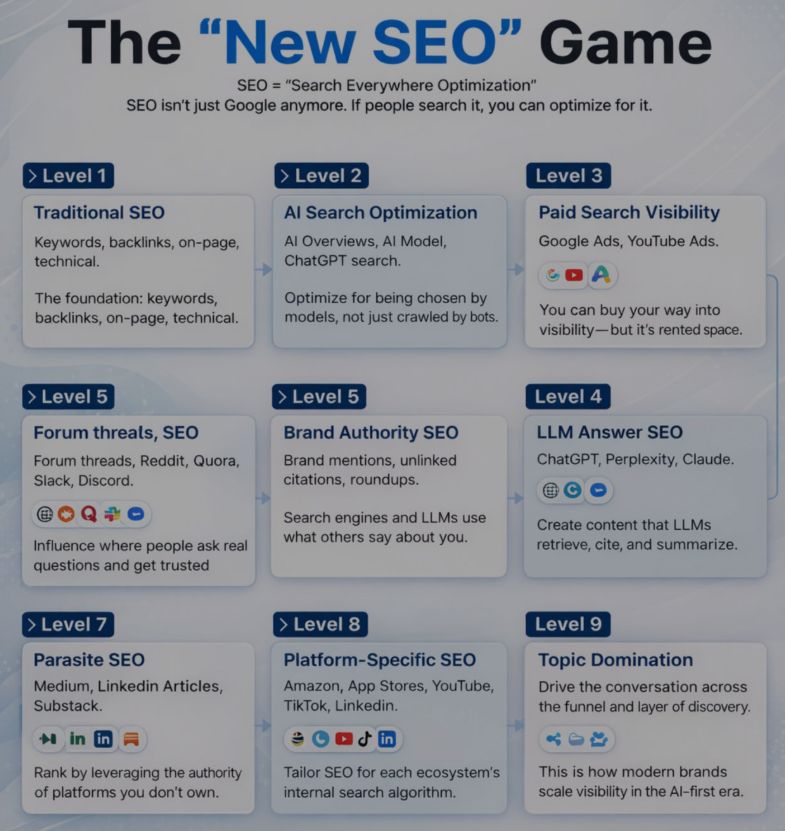
Understanding the New Meaning of SEO: Search Everywhere Optimization
Modern SEO can be best explained as Search Everywhere Optimization.
If people are searching for solutions related to your business, your brand or expertise should appear in some form — whether it is a blog, a video, an answer, a mention, or a recommendation. Visibility today is fragmented, but trust connects it all.
This means SEO is no longer limited to your website alone. It now includes your presence across platforms, communities, and AI-driven systems. Ignoring this reality is the biggest reason many SEO strategies fail silently.
Traditional SEO Still Matters, But Only as a Foundation
Let me be very clear here — traditional SEO is still important. Your website still needs proper structure, clean technical setup, useful content, and a good user experience. Without these basics, nothing else will work.
However, traditional SEO is only the starting point, not the destination.
Think of it like this: traditional SEO builds the road, but modern SEO decides how many people actually travel on it and trust it.
At this level, the focus should still be on things like:
-
Clear site structure and internal linking
-
Helpful, original content written for users
-
Fast loading speed and mobile friendliness
-
Logical keyword usage without over-optimisation
Once this foundation is stable, the real game begins.
How AI Has Changed Search From Ranking Pages to Choosing Answers
One of the biggest changes in SEO today is the role of AI. Earlier, search engines ranked pages. Today, AI systems select answers.
When someone asks a question to ChatGPT or sees an AI Overview on Google, they are not comparing ten links. They are consuming one summarised response. This means your content is not just competing for ranking; it is competing for clarity, trust, and usefulness.
AI prefers content that explains concepts in simple language, shows experience, and answers real questions completely. Content written only for keywords or algorithms gradually disappears without any warning.
This is why human-friendly writing has become a core SEO skill.
The Role of Paid Search: Helpful but Not Sustainable Alone
Paid ads still play an important role in digital visibility. Google Ads, YouTube Ads, and other paid platforms can give quick exposure and help test offers or markets. However, paid visibility has one major limitation — it stops the moment you stop paying.
SEO, on the other hand, builds long-term presence.
In a balanced strategy, paid ads should support organic efforts, not replace them. Brands that depend only on ads often struggle with rising costs and unstable growth, while brands with strong SEO enjoy compounding visibility over time.
Answer-Based SEO: Writing Content That AI and Humans Trust
Today, content is consumed by both humans and AI systems. AI tools read, summarise, and recommend content based on clarity and context, not just keywords.
Content that works well in this environment usually has certain qualities:
-
It explains topics step by step
-
It uses natural, conversational language
-
It answers real user questions clearly
-
It reflects real experience, not theory
This is why shallow, copied, or generic content struggles even if it is technically optimised.
Why Forums and Communities Matter More Than Ever
People trust people more than websites. Today, real questions are asked on platforms like Reddit, Quora, Slack groups, and niche communities. When someone sees a genuine answer from a real person, that builds far more trust than a polished sales page.
Search engines and AI systems observe these conversations quietly. They learn who helps, who educates, and who adds value. Participating in communities with the right intent builds strong, long-term authority signals.
Brand Authority: The Real Power Behind Modern SEO
Modern SEO is heavily influenced by recognition. Who gets mentioned? Who feels familiar? Who is trusted?
Brand authority is built when people repeatedly see your insights, content, or name associated with a topic. Once that happens, rankings, clicks, and conversions become easier.
Without authority, SEO feels like constant struggle. With authority, SEO feels natural.
Platform-Specific SEO: One Strategy Does Not Fit All
Every platform has its own discovery logic. What works on Google may not work on YouTube. What works on LinkedIn may not work on Amazon.
Understanding how each platform ranks and recommends content is now part of SEO. Brands that adapt their message and format for each platform perform far better than those who blindly copy-paste the same content everywhere.
Topic Domination: The Highest Level of the New SEO Game
The final stage of modern SEO is topic domination. This is when you don’t just rank for one keyword, but you become known for a subject. Your content appears across platforms and stages of the user journey, from awareness to decision-making.
When people repeatedly see your perspective, your name becomes associated with that topic. This is how long-term visibility is built in an AI-first world.
Conclusion: SEO Is Not Dead, But Lazy SEO Is
SEO is very much alive. It is evolving with user behaviour, platforms, and technology. What is dying is shortcut-based, mechanical SEO that ignores trust and experience.
The future of SEO belongs to those who educate, guide, and build credibility over time. When we align our efforts with how people actually search and learn, results follow naturally.
Before you go, I would genuinely like to hear from you. How did you feel reading this blog? Have you faced similar SEO challenges recently? Do you agree with this new direction of SEO, or do you see it differently?
Share your thoughts, experiences, or ideas. Real discussion is where real growth begins.

Grow your brand with Devetol Advertising! We specialize in digital marketing solutions. Visit Devetol.com for a free consultation. SEO , Social Media, PPC, Content Writing PR, Digital Advertising, Web Marketing Leads, PR